Presidents Column June, 2025
By Mark Galizio
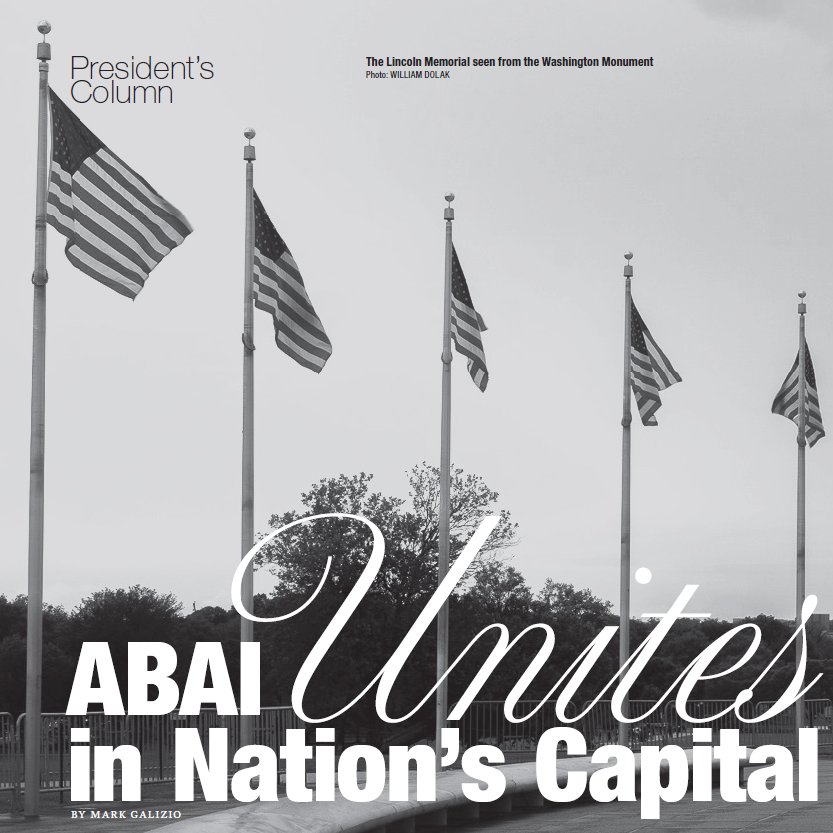
Washington, DC is an exciting place to be on any Memorial Day weekend, but this year it reached an even higher pitch for us as behavior analysts from all over the world converged for the 51st Annual Meeting of the Association for Behavior Analysis International (ABAI). I’ve attended all but a few of those 51 meetings and this one really stood out with numerous outstanding presentations, many festive social events, and 3,508 enthusiastic attendees! There were far too many superlative events to feature them all, but I will note a few personal highlights below.
The action started early for some of us as 29 workshops were held Thursday and Friday (May 22/23) providing training across a wide range of program areas including Autism, Clinical/Family/ Behavioral Medicine, Developmental Disabilities, Education, Organizational and Behavioral Systems Analysis, Philosophical, Conceptual and Historical Issues, and Verbal Behavior and Cognition.
On Friday evening, our amazing Student Committee staged their Student Welcome session along with Student Trivia night. There were also several Special Interest Group business meetings, and the evening wrapped up with the International Reception hosted by Marcelo Benvenuti (University of Sao Paulo) that celebrated the diversity and global reach of ABAI’s membership. And all this before the conference opening event!
The Society for the Advancement of Behavior Analysis (SABA) awards were featured at Saturday’s opening event chaired by SABA President Chris Newland. This is always one of my favorite sessions because not only do we honor our outstanding colleagues, but each awardee gives a short presentation reflecting on some aspect of their distinguished careers. I often find these talks to be among the high points of the meeting and this year’s awardees did not disappoint! The first award for Distinguished Service to Behavior Analysis was to two-time ABAI President Mike Perone (West Virginia University) who has served our field in so many ways. Although the title of his talk (Things I Have Learned About Service—So Far) seemed remarkably inauspicious to me, those familiar with Mike as a speaker were not surprised that his presentation was insightful, funny and poignant. Hopefully all who heard it were inspired to volunteer for ABAI service work (we always need volunteers)!
The SABA Award for Scientific Translation went to Tim Hackenberg (Reed College), whose high-impact research has made signal contributions across a wide range of topics. His presentation on token economies epitomized the best of translational science as his work has spanned the continuum from basic research on token reinforcement in animals to use of token economics in applied settings. Although not able to attend the meeting, Julio de Rose (Universidade Federal de Sao Carlos) received the SABA Award for International Dissemination for his critical role in the development of behavior analysis in Brazil. The Award for Effective Presentation of Behavior Analysis in the Mass Media went to Alexandra Kurland (The Clicker Center) who hosts a weekly podcast called “Equiosity.” She is known for bringing clickers and positive reinforcement to the horse training world and has used behavioral principles to facilitate a shift away from aversive control in horse training. The final award for Enduring Programmatic Contributions went to the University of Guadalajara Center for Behavioral Students and Research and was accepted by Carlos de Jesus Torres, who described the distinguished history of the program (I have fond memories of presenting a mini-course there many years ago as part of their visiting faculty series).
After the single track Awards Ceremony concluded, we were all faced with the challenge of which of the many talks to attend (a problem throughout the conference!). I was fortunate enough to attend Ami Klin’s (Marcus Autism Center) brilliant presentation in the Doreen Granpeesheh Speaker Series: “Toward ABA Leadership in the Science of Profound Autism: Challenges and Opportunities.” He discussed a number of interesting developments on the genetics, neuroscience, and early diagnostic markers of profound autism and the importance of ABA leadership to translate these advances into clinical practice.
Saturday continued with a total of 92 panels, paper sessions, tutorials, and symposia. I enjoyed a cutting-edge symposium on relapse mitigation chaired by Carla Martinez-Perez (University of Florida) and on to the first of three poster sessions. Each session was loaded with great research with 421 total posters (Saturday,145; Sunday, 143; Monday, 133). The sessions were exciting and busy with lively conversations along every aisle. Posters are a great way to get an early view of cutting-edge science across every subarea of behavior analysis. It was impossible to visit all of the posters in any of the two-hour sessions. I made a short list of the ones I most wanted to see, but even so, I couldn’t take them all in.
Special events following the poster session included a B F Skinner lecture from Kostadin Kushlev (Georgetown University) entitled “The Digital Paradox: Why Smartphones Haven’t Made Us Happier and How to Reclaim our Well-Being.” We also had presentations from the winners of the Scholarly Contributions to Diversity, Equity and Inclusion Paper competition: Zeinab Hedroj (University of Nebraska Medical Center’s Munroe-Meyer Institute) and Denise Passerelli (Universidade Federal de Sao Carlos). My Presidential Address “Found in Translation” was the final Saturday presentation. I tried to make the point that translational science provides a bridge that unites all behavior analysts across our many different areas of specialization and interest. But the evening was still young, and the ABAI Expo delighted many of us well into the night.
Sunday’s events opened with two interesting, invited talks: Barbara Esch (Esch Behavioral Consultants) on “Living a Behavior Analytic Life: Skinner’s Legacy Applied” and Mark Bouton (University of Vermont) on the role of attention as a factor in the distinction between goal-directed and habitual behavior. I enjoyed a symposium chaired by Stephanie Gonzalez (University of North Texas) on “Remembering Past Events: A Survey of Recent Basic and Applied Behavioral Research in Episodic Reporting.” Presenters provided behavioral approaches to topics traditionally seen as in the purview of cognitive psychologists (full disclosure—I was a co-author on one of these presentations).
Another symposium that I found of great interest was “Recent Evaluations of Timeout Procedures in Basic and Applied Research” chaired by Haillie McDonough (Northern Michigan University). Although timeout is among the most widely used behavioral techniques world-wide, there is relatively little research on its effects and many unanswered questions, but the presenters in this symposium are starting to address several of these.
One of the late Sunday presentations that I found of great value was a B F Skinner Lecture by Julianne Baron, Executive Director of the Federation of Associations in Behavioral and Brain Science (FABBS), of which ABAI is a member. She chronicled the devastating impact that funding cuts have had at the National Science Foundation, the National Institutes of Health, and other federal scientific agencies and urged us to work with FABBS to defend science. After a packed Sunday of talks, it was great to relax later at the evening’s reunions and chat with old friends and former students.
Monday’s events started bright and early with the Annual Business Meeting kicking things off at 7:00 a.m. Each of our board coordinators presented their annual reports: Mitch Fryling-Program, Benjamin Witts (St. Cloud State University)-Education, Ramona Houmanfar (University of Nevada-Reno)-Publications, Claudia Drossel (Eastern Michigan University)-Practice, Jonathan Pinkston (University of Kansas)-Science, Gordon Bourland (Trinity Behavioral Associates)-Chapters, Rocio Rosales (University of Massachusetts-Lowell)-Membership, and Jovonnie Esquierdo-Leal (California State University, Fresno)-Diversity, Equity and Inclusion. These reports gave us all a brief view of the amazing range of activities in support of behavior analysis provided by ABAI.
After the Business meeting, I wandered over to a remarkable invited address by John Wixted (University of California, San Diego) on eyewitness memory. Conventional wisdom has it that wrongful convictions often occur due to faulty eyewitness memory. John’s research has revealed that, in fact, eyewitnesses are actually quite reliable (especially if they express confidence in their identification)—IF they are questioned shortly after the event. However, trials do not take place until months or years later, and it is here that faulty identifications are more common. John’s testimony as an expert on eyewitness memory has been used to exonerate several people who were wrongly convicted, and this research has clear implications for the justice system.
Monday continued with many great talks, symposia and panel discussions and culminated with the final speaker, Presidential Scholar Ed Wasserman (Iowa University) who described how many innovative behaviors that seem to appear through design can be understood, not through the genius of the innovator, but rather through shaping by consequences. His talk provided many examples of such shaping (including the development of B F Skinner’s pigeon guidance system) and was a fitting conclusion to a great program that included 312 total sessions.
But the Monday night ABAI Social Event was still to come—with two separate venues no less! And that reminds me to mention that a great many of the conference highlights for me were not in the program. They included catching up with dear friends and making several new ones. Those impromptu chats in the hallway and in the corridors of the poster session are always special events. I’m often delighted to get excited by a talk and then inspired to read new things or design a new experiment. These are some of the intangible rewards that make the conference experience so special (and were sorely missed when we were online during the COVID times).
Congratulations and thanks go to Program Board Coordinator Mitch Fryling and Program Committee Chair Linda Hayes and the many Program Area Coordinators whose work was critical in making the conference such a success. I also want to acknowledge the extraordinary contributions of Program and Convention Managers Maria Malott (ABAI) and Jessica Van Stratton (ABAI) as well as the rest of the ABAI team who somehow manage to keep all the moving parts on track. Finally, I am pleased to announce new Executive Council members: President-Elect–Ramona Houmanfar, At-Large Representative–Len Green (Washington University), and Student Representative-Elect–Daniela Galvis-Quintana (University of Nevada-Reno ).
I am looking forward to seeing everyone at next year’s Annual Meeting to be held in San Francisco, May 21-25, 2026. But if you are already jonesing for another conference (I certainly am!), consider attending the Single Case Conference, September 26-28, 2025 in Minneapolis; the Twelfth International Conference in Lisbon, Portugal, November 11-13, 2025; and the 20th Annual Autism Conference in New York City, January 15-17, 2026. I hope that you can join us for some of these special events!
About Author